
Region touts defence opportunities at local defence growth forum
Region touts defence opportunities at local defence growth forum
Region touts defence opportunities at local defence growth forum
By BRENDAN MILLER on October 30, 2026.
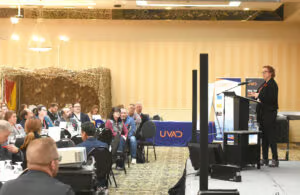 The sold-out defence growth forum drew 220 attendees from across Canada to explore regional defence assets and discuss industry growth. - NEWS PHOTOS BRENDAN MILLER
Medicine Hat held a large-scale Defence Growth Forum on Thursday to highlight the region’s growing opportunities as an innovation and research hub, home to world-class military research as well as a large testing and training ground.
The sold-out two-day event brought 220 established companies, startups, researchers, entrepreneurs and economic development leaders under one roof for a networking and informational event discussion on defence funding, building partnership, strengthening capabilities and identifying new opportunities within the defence ecosystem from across Canada.
The forum, hosted by Community Futures EntreCorp Businesses Development, included an industry tradeshow Wednesday evening held at Medicine Hat Lodge followed by an all-day forum with speakers Thursday.
“Southeast Alberta, Medicine Hat has amazing history and technology and opportunities in the defense world, so we wanted to share where those opportunities are,” said Sean Blewett, general manager of Community Futures EntreCorp.
Several keynote speakers took to the stage on Thursday to provide information on CFB Suffield, DRDC Suffield, a new unique $750-million DRDC construction project, local drone and defence companies and support programs for businesses and ways to access grant funding provided by governments.
The timing of the forum falls in line with an increased spending on national security as Canada looks to allocate more than $163 billion toward military by the mid-2030s and has accelerated its path to meet the NATO spending benchmark of five per cent of annual GDP by 2035.
In Alberta, regional investments are approximately $8 billion in defence infrastructure, including $750 million for a new chemical, biological, radiological and nuclear lab and assessment centre at Suffield that will be a unique building and possibly the only of its kind in the world, according to experts.
The increased spending in domestic defence manufacturing is allowing local companies in Medicine Hat, including Landing Zones, to expand operations, hire more employees and grow the local economy.
“They’re looking for those young people to come in and work in their industries, and these are high-paying jobs. They’re engineering jobs, they’re very technical jobs,” explains Blewett. “The city and the county and the region are always looking to attract companies. I think there’s a lot of opportunity for startup companies as well.”
Development of drone technology has been occurring at Suffield for more than 40 years working with both industry and post-secondary institutions to develop and advance the technology being utilized in global conflicts around the world.
“In the current operating environment internationally we see a rise in the prominence of drones,” said Huge Atwell, centre director of suffield research centre. “It’s not something that has happened in the last year or two, it’s really a phenomenon that’s been developing over the last half century.”
However, in recent years innovation within the sector has been developing rapidly, and Canada is taking notes from development occurring in the ongoing conflict between Russia and Ukraine.
“Driving that technological adaptation in militaries across the globe, so not new to us, but certainly increased prominence placed on it so for our part, we’re looking at scaling up our ability to actually work with industry and academia in order to meet that demand for the Canadian Forces for the defence of Canada.”
Atwell describes several innovations relevant to drone technology.
“It’s extremely rapidly advancing and really there are many different technologies that combine together to make a military-relevant drone capability.”
Atwell says technologies are being tested to make sure drones are fully autonomous as opposed to remote controlled by a human operator, the use of several different detection technologies that may be integrated within as well as weaponizing some of the platforms.
“Becuase if we have those capabilities, for sure, adversaries will have those as well, and that is of course something that we’re seeing in theatres like Ukraine, but also events in the public safety type of environment, and we do research and development that supports public safety.”
Last month CFB Suffield held a large-scale “sandbox” event that provided selected companies from across Canada and around the world an opportunity to test innovations in drone technologies at its testing range.
The sandbox included several subject-matter experts and scientists who were able to generate reports of the demonstrated technologies that were tasked with shooting down an incoming energy drone, and showcased technologies like high powered lasers, kinetic energy, nets, shotguns and frequency jamming mechanisms were tested.
The forum also included an economic update from ATB’s deputy chief economist Rob Roach, The Next Chapter for CFB Suffield, defence research at CFB Suffield, federal programs that support business growth, building chemical and biological labs, Foremost UAS test range, next waves of drone defence, future aviation defence, Alberta aerospace and fence economy and advancing Alberta defence and security ecosystems.
The Southeast Alberta Chamber of Commerce says few regions can offer the combination of assets already found in southeast Alberta, such as CFB Suffield, Canada’s largest military training area, Defence Research and Development Canada Suffield, British Army Training Unit Suffield and the Foremost UAS Test Range.
By Brendan Miller, with Medicine Hat News