
Council to view proposed changes to Land Use Bylaw
Council to view proposed changes to Land Use Bylaw
Council to view proposed changes to Land Use Bylaw
By BRENDAN MILLER on April 24, 2026.
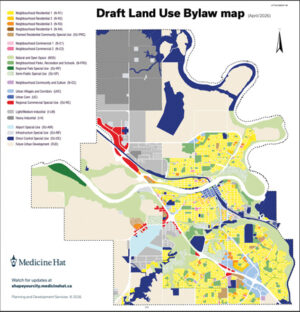 This map shows new proposed zoning changes to the city's Land Use Bylaw. These changes will be presented to council on May 4 for its first consideration and expected to make a decision on June 1.--IMAGE COURTESY CITY OF MEDICINE H
City staff have recommended changes to the Land Use Bylaw, seeking more certainty and district options to regulate how land and buildings are developed, designed and used.
Since 2016 the city’s Land Use Bylaw has undergone five amendments that have included improvements carried over into a proposed bylaw, which council will soon consider.
The scope of the most recent changes, presented to members of the municipal planning commission Wednesday, focuses on providing more certainty in future developments and aims to distribute density, heights and form across more districts.
“It’s quite simple,” explained Jim Genge, superintendent of planning. “More districts, more use-definitions, more use-specific rules. These are the kinds of changes that work to distribute density, height, build form and intensity of development across more districts.”
The current bylaw includes 18 land-use districts and 69 use definitions. Proposed changes will grow the bylaw to 21 land-use districts and 139 use definitions.
“These kinds of changes allow for fine-tuning of what uses can be developed in each district, improving predictability of what can go where, and it also facilitates a better transition between all types of land uses,” explained Genge.
Changes also include adding 38 more general definitions, 14 more use specific regulations and nine more development permit exemptions.
Genge says these new additions will improve the clarity of potential interpretation of what can be developed within different land-use districts, and could lead to fewer appeals and more permit exemptions.
Since 2022 the city has held several engagement events and activities with staff on hand to speak with residents and hear concerns over the current bylaw, including several municipal open house events as well as the LUB Refresh Survey conducted in July 2024.
Genge says feedback from the public is a key driver for some of the proposed changes and provided committee members an example of a transition between residential densities.
Under the current Land Use Bylaw there are three different zoning classifications for residential housing; Low Density Residential, Medium Density Residential and High Density Mixed Use.
“Market conditions have resulted in increased applications for various forms of multiple unit housing,” said Genge. “Residential densities are a key issue for the public.”
Proposed changes would split these three districts into five; Neighbourhood Residential 1 – 4 and Planned Residential Community Special Use.
This draft system would classify N-R1 as low-density housing like detached houses, semi-detached housing and stacked duplex housing.
N-R2 includes low- to medium-density like row housing or multi-unit housing, however all properties included in N-R1 and N-R2 must be three storeys or fewer.
Buildings from four to six storeys could be developed in N-R3 zoning, and six storeys or higher would fall into the N-R4 zoning district.
Gange says these changes look to support applications for multi-unit housing, which often face a “high risk” for appeals.
“This can discourage development industry investment,” he added.
Staff say an increasing number of land-use-related issues have generated significant feedback from city council and residents, as well as the development industry.
They also say regular meetings with industry stakeholders, including the Development Advisory Panel, Urban Development Institute and local Chamber of Commerce, have influenced proposed changes.
“The emergence of these land-use issues and the expressed concerns of the community provides an opportunity for council to ensure that Land Use Bylaw regulations are aligned with community expectations,” reads the city’s Request for Decision documents that will be provided to council.
Committee members recommended proposed changes be presented to council, with the first reading expected at the May 4 public meeting, with second and third readings scheduled for June 1.
If approved, city staff will begin to implement, monitor and evaluate the new changes of the Land Use Bylaw and report back to council and the municipal planning commission with any required adjustments.
By Brendan Miller with Medicine Hat News.
Online link: https://medicinehatnews.com/news/local-news/2026/04/24/council-to-view-proposed-changes-to-land-use-bylaw/